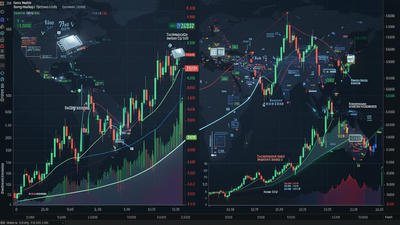
Semiconductors and crude oil do not look like obvious relatives. One is associated with AI chips, advanced packaging, foundries, and global technology supply chains. The other is tied to energy markets, geopolitics, transportation, and inflation. Yet when investors study market correlations closely, the relationship between semi indicators and crude oil prices becomes surprisingly interesting. It is not just whether the two move together. It is whether they move together differently when oil rises versus when oil falls. That asymmetry is where the real signal often lives.

An asymmetric correlation study asks a simple but powerful question: do semiconductor indicators react the same way to positive oil shocks as they do to negative oil shocks? If the answer is no, then crude oil is not just a background macro variable. It is a directional force with different implications depending on the type of move. In semiconductors, that distinction matters because the sector is highly sensitive to manufacturing costs, logistics, inflation expectations, and risk sentiment. A rise in crude oil can affect semis differently from a decline in crude oil, and the market may not price those effects symmetrically.
Why These Two Markets Are Linked
At first glance, semiconductors and crude oil seem to belong to different universes. But both are deeply tied to the real economy. Oil affects transportation, industrial production, energy-intensive manufacturing, and inflation. Semiconductors depend on global supply chains, fabrication plants, equipment logistics, and customer capex. When oil prices move, they can change cost expectations, margin assumptions, and even the market’s appetite for risk assets.
For semiconductor indicators, crude oil matters in several ways. Higher oil prices can raise transportation and input costs, which may eventually feed into inflation and pressure valuations. Lower oil prices may reduce cost pressure and improve sentiment, but they can also signal weaker global demand if the decline is driven by economic slowdown rather than supply abundance. That is why the relationship is not symmetric. A move in oil is not just a move in oil. It is also a message about growth, inflation, and market risk.
What Asymmetry Means
An asymmetric correlation study looks for differences in how one asset responds to positive versus negative changes in another. In this context, it asks whether semiconductor indicators respond differently when crude oil goes up than when it goes down. The answer often turns out to be yes. Markets do not process gains and losses in the same way. A sharp oil rally may trigger inflation fears and rate concerns, while a sharp oil decline may be interpreted either as a cost benefit or as a demand warning.
That means semiconductor indicators can show asymmetric behavior. They may be more sensitive to oil spikes than to oil drops, or vice versa. In some periods, rising oil may hurt semis more than falling oil helps them. In other periods, falling oil may benefit semis more than rising oil hurts them because lower input costs and a softer inflation backdrop support valuations. The point is that the relationship is not linear. It depends on the market regime and the story behind the move.
Why Semis Are Sensitive to Oil Shocks
Semiconductors are not an energy sector, but they are not immune to energy prices either. Several mechanisms connect the two. First, higher oil prices can raise the cost of transportation, raw materials, and production logistics. Semiconductor supply chains are global and complex, so energy costs can move through the system in subtle ways. Second, oil price spikes can feed inflation expectations, which may put pressure on interest rates and growth stock valuations. Semiconductor stocks are often valued on future earnings, so higher discount rates can matter a lot.
Third, oil price moves are often interpreted as macro signals. A sharp rise in crude may be seen as inflationary and possibly negative for risk assets. A sharp drop in crude may be interpreted as relief for margins, but it may also signal weaker world demand. In either case, semiconductor indicators may react, but not necessarily in the same magnitude or direction. That is where asymmetry enters the picture.
This is especially relevant in the current era of AI and advanced packaging, where semiconductors are seen as strategic growth assets. Even if their direct energy exposure is limited, their valuation can still be affected by oil through macro channels.
The Positive Shock Side
When crude oil rises, the market often worries about inflation, cost pressure, and tightening financial conditions. For semiconductor indicators, this can be negative if investors begin to discount future cash flows more aggressively or if they fear a broader slowdown in technology spending. Higher oil prices can also raise concerns about demand destruction in transportation, manufacturing, and consumer sectors, which may eventually feed into the semiconductor supply chain.
However, the effect is not always straightforward. In some environments, rising oil can coincide with strong global growth, robust industrial activity, and healthy demand for electronics. In that case, the negative effect of oil on semis may be muted. The market may focus more on the growth backdrop than on the cost backdrop. That is why the positive-shock side of the relationship should be read carefully. Oil is not always bad for semis when it rises. It depends on whether the move reflects inflation stress or healthy demand.
An asymmetric study tries to separate those possibilities by looking at how semi indicators behave specifically after oil up-moves. If the response is disproportionately negative, then the market is telling us that inflation and valuation concerns dominate. If the response is modest or mixed, then oil may not be as important as other drivers.
The Negative Shock Side
When crude oil falls, semiconductor indicators may benefit from lower input and transportation costs, lower inflation pressure, and a more supportive environment for growth valuations. In many cases, falling oil is interpreted as a positive for risk assets. It can reduce pressure on margins and improve the market’s willingness to pay for earnings growth. That should help semiconductors, especially those tied to AI, advanced packaging, and capex-led demand.
But here too the reaction can be asymmetric. A drop in oil prices is not always good news. If the fall reflects deteriorating global demand, then semiconductors may not benefit much. In fact, they may suffer if the market begins to price in slower end-market demand, weaker industrial activity, or caution from corporate buyers. That means the negative-shock side can be just as complex as the positive-shock side.
This is why crude oil and semis do not always move in opposite directions. Sometimes both directions produce caution, just for different reasons. The positive shock may worry investors about inflation, while the negative shock may worry them about growth.
What the Correlation Can Hide
A simple correlation number can hide a lot. If the relationship between oil and semi indicators is asymmetric, then an average correlation may look weak even when the underlying conditional relationship is strong. That means investors may underestimate how much oil matters during specific market phases.
For example, if semis respond strongly to rising oil but only weakly to falling oil, the average correlation may appear modest. But the market would still be quite sensitive to inflationary oil shocks. Conversely, if semis benefit sharply from falling oil but ignore oil rallies, the average correlation may again look small even though the downside and upside channels are very different.
That is why asymmetric studies are useful. They reveal whether the sector is behaving like a one-way risk asset or a more nuanced macro-sensitive market. For semiconductor investors, that can be extremely valuable because it helps distinguish cost-driven effects from demand-driven effects.
How the Sector Has Changed Over Time
The semiconductor industry has changed so much over the last decade that the oil relationship may itself have evolved. In earlier years, semis may have been more directly sensitive to broad manufacturing and logistics costs. Today, the sector is much more influenced by AI demand, advanced packaging, foundry specialization, and memory bottlenecks. That does not eliminate the oil connection, but it may weaken or redirect it.
In other words, oil may matter less as a direct input and more as a macro signal. Higher oil may still raise inflation concerns, but semis may now respond more to how oil affects interest rates, corporate capex, and risk appetite than to direct cost changes. That shift can make the relationship more indirect and more asymmetrical.
This matters because older historical correlations may not describe the current market very well. The modern semiconductor sector is more strategic, more capital intensive, and more tied to long-duration growth themes. That can alter the way oil shocks are transmitted.
Why Advanced Packaging Matters Here Too
Advanced packaging and heterogeneous integration add another layer to the story. As semiconductors move toward chiplets, 3D stacking, and AI-centric architectures, the package becomes more important than ever. That can change how the sector responds to crude oil because the economics of advanced packaging depend on complex global supply chains, precision manufacturing, and high-value production. These systems may be less directly exposed to oil than traditional manufacturing, but they are still influenced by transportation, energy, and macro sentiment.
If oil rises sharply, the market may worry about inflation, which can pressure valuation multiples on these high-growth packaging-driven names. If oil falls because the economy is slowing, then demand expectations for AI infrastructure or consumer electronics may weaken. So advanced packaging does not eliminate the oil connection. It just changes its form.
That is one reason asymmetric correlation studies are so useful in modern semiconductors. They can help separate the sector’s direct operational sensitivity from its market sentiment sensitivity.
What Investors Should Watch
Investors studying semi indicators and crude oil prices should pay attention to several questions:
- Does the semiconductor index react more strongly to oil rises than oil falls?
- Do oil shocks matter more when inflation expectations are already elevated?
- Is the oil move being driven by supply shocks or demand shocks?
- Does the semiconductor market respond differently during AI-led growth phases than during cyclical slowdowns?
These questions matter because the market reaction to oil is often conditional. A supply shock in oil may trigger a very different semiconductor response than a demand shock. A rise in crude during a strong global growth phase may not hurt semis much, while the same rise during a fragile macro environment may have a much larger effect. The asymmetry is not constant, but it is informative.
Trading and Portfolio Implications
From a trading perspective, asymmetric correlation can be useful for hedging and timing. If semi indicators are more vulnerable to oil spikes than to oil drops, then crude oil can act as an early warning signal for sector risk. If semis benefit more from oil declines than they are hurt by rises, then falling oil may support a bullish semiconductor view. Either way, the relationship can be incorporated into portfolio decisions.
For example, a semiconductor investor who sees crude oil rising sharply might become more cautious about valuation-sensitive names. A portfolio manager who notices oil falling for demand-related reasons might reduce exposure even if the direct cost benefit seems positive. That kind of nuanced interpretation is the value of asymmetry analysis. It helps investors avoid simplistic “oil up bad, oil down good” thinking.
In a world where semiconductors are intertwined with AI, advanced packaging, and global capex cycles, these subtleties matter more than ever.
The Broader Message
The broader message of an asymmetric correlation study is that semiconductor indicators are not isolated from the macro world. They are connected to energy prices, but not symmetrically. That connection can reveal how the market thinks about inflation, growth, and risk. It can also highlight when semis are behaving more like a pure technology trade versus a macro-sensitive asset class.
That is especially important now that semiconductor indices are being used as proxies for AI, manufacturing, and global innovation leadership. If crude oil moves are affecting semis differently depending on direction, then investors are getting a richer signal than a simple correlation number can provide. They are seeing how the market filters macro shocks through the semiconductor lens.
Conclusion
The relationship between semiconductor indicators and crude oil prices is not symmetric, and that is precisely why it is worth studying. Positive oil shocks and negative oil shocks can affect semis differently because they carry different messages about inflation, growth, and risk appetite. For a sector as globally integrated and strategically important as semiconductors, those messages matter.
An asymmetric correlation study helps investors move beyond simple assumptions. It shows that oil is not just an energy story. It is a macro signal with sector-specific consequences. And in semiconductors, where valuation, supply chains, and advanced packaging all interact with the broader economy, that signal can be especially meaningful. The key is not to ask whether oil and semis are linked. The key is to ask how they are linked, and whether that link changes when oil moves up versus when it moves down.